
Plumbing Leads: The Plumber's Buying Guide

A low-priced plumbing lead can still cost you if the prospect doesn’t answer, isn’t qualified, or has already contacted several contractors. The right buying model depends on more than the price per inquiry: it has to fit your team’s response capacity and produce jobs at an acquisition cost your business can support.
It’s frustrating to pay for prospects who aren’t ready to book, especially when you’re also racing other contractors to reach the same person. And if you track lead spend without connecting it to booked and completed work, it’s hard to know which source is actually paying off.
This guide shows you how to assess plumbing leads by intent, exclusivity, and contactability, then compare exclusive leads, shared leads, and inbound calls on practical business criteria. You’ll also learn how to calculate cost per acquired job and evaluate payback against job value, so you can choose an approach that suits your sales capacity and the work you want to book. The goal isn’t simply to buy more inquiries. It’s to build a lead process you can measure and grow with confidence.
Key Takeaways
- Separate a prospect inquiry from a booked appointment or completed job when assessing pipeline value.
- Compare exclusive, shared, aged, and live-call plumbing leads by freshness, competition, contact format, and fit for your team.
- Track contact, appointment, and close rates consistently to calculate cost per acquired job, not just cost per lead.
- Build a follow-up process with clear ownership and recorded outcomes so you can see where opportunities stall.
- Match lead volume and format to your team’s response capacity before deciding which approach to scale.
What Plumbing Leads Mean for a Contractor’s Pipeline
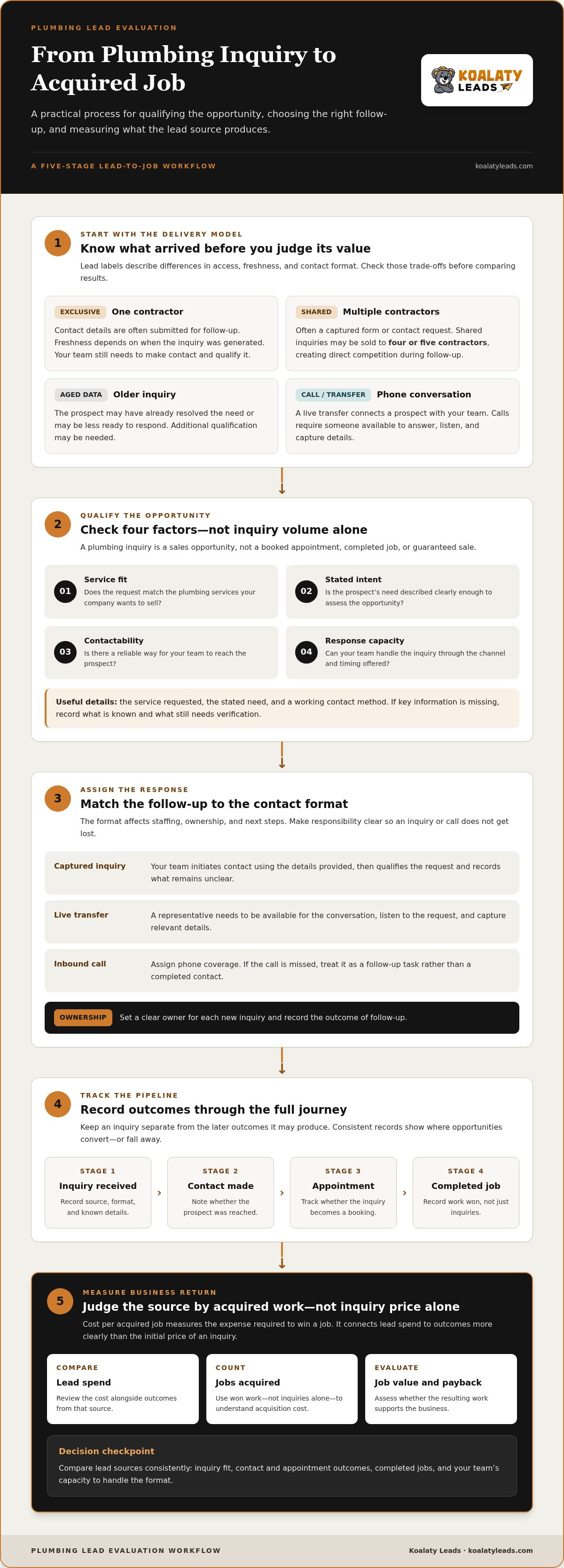
A plumbing lead is a prospective customer inquiry a contractor can pursue. It gives your business an opportunity to assess fit, make contact, and potentially book work, but it is not itself a booked appointment, completed job, or guaranteed sale. Contractors evaluating plumbing lead options should treat each inquiry as a sales opportunity to qualify, not a promised result.
The value of an inquiry depends on whether it matches the services you want to sell, whether the prospect is ready to speak, and whether your team can respond. A name and phone number may be a starting point; the next steps determine whether it becomes a real sales opportunity.
Which plumbing inquiries can become sales opportunities?
An inquiry is more useful when it identifies the service requested, describes the stated need, and gives your team a way to reach the prospect. For example, a request that names a service category and includes a working phone number offers a clearer starting point than a record with only a name and limited context.
Format matters, too. A captured inquiry may require your team to initiate contact; a live conversation or transferred call connects you with someone ready to speak at that moment. Neither format guarantees a sale, but the distinction affects staffing, ownership, and follow-up. A broader Plumbing industry overview illustrates how varied the trade is, which makes clear service information useful when sorting opportunities.
Incomplete details can slow qualification. If the service requested or a reliable contact method is missing, your staff may need extra attempts to establish fit before deciding who should handle the opportunity. Record what is known, note what remains unclear, and avoid treating an unverified inquiry as a confirmed job.
Why lead quality is more than lead volume
A high inquiry count can look promising while producing little useful pipeline. If the requests don’t match your company’s services, the prospects aren’t ready to talk, or your team can’t reach them, volume alone won’t show whether the source supports growth.
Assess quality across four practical factors: service fit, stated intent, contactability, and your capacity to respond. A relevant inquiry that your team can reach and handle is more actionable than a larger batch with missing details or unclear needs. Keep those factors visible in your records so lead sources can be compared on consistent terms.
Then connect lead spend to acquired work. Cost per acquired job measures the expense required to win a job, rather than simply counting inquiries or comparing their initial prices. It gives owners and managers a clearer way to judge whether a lead source contributes to profitable growth. The next step is tracking the stages between inquiry and completed work, so you can identify where opportunities convert or fall away.
Exclusive, Shared, Aged, and Live-Call Plumbing Leads Compared
Lead labels describe different trade-offs in access, freshness, and follow-up. For plumbing companies, the right fit depends on how your team handles new inquiries and whether it can respond through the channel offered. Each model has distinct operational demands, so compare the delivery format and competition alongside the information provided with an inquiry.
| Lead type | Exclusivity | Freshness and format | Competition and operational trade-offs |
|---|---|---|---|
| Exclusive inquiry | Delivered to one contractor | Often contact details submitted for follow-up; freshness depends on when it was generated | No competing contractors receive that same inquiry through the sale, but your team still needs to make contact and qualify it. |
| Shared inquiry | Distributed to multiple contractors | Often a captured form or contact request | Shared inquiries may be sold to four or five contractors as a category practice. Your team may face direct competition when following up. |
| Aged data | Varies by source and terms | An older inquiry, generally supplied as contact information rather than a current conversation | The prospect may have already resolved the need or may be less ready to respond, so additional qualification may be needed. |
| Inbound call or live transfer | Depends on the arrangement | Direct phone conversation; a transfer connects the prospect with your team | Requires someone available to answer, listen, and capture details. A missed call creates a follow-up task. |
How exclusive and shared plumbing leads differ
An exclusive inquiry is routed to one contractor rather than shared with competing contractors. That reduces direct competition for the same prospect, but exclusivity can’t ensure the person answers, books an appointment, or buys. A shared inquiry can offer a different volume profile while requiring your team to compete for the prospect’s attention during follow-up.
Some lead services use an aggregator marketplace model, collecting inquiries and distributing them among contractors. In bid-to-appear models, contractors compete for visibility, which can affect how often they are shown to prospective customers. Each approach has trade-offs in competition, control, and follow-up; the label alone doesn’t tell you how an inquiry will perform.
When calls and live transfers fit a plumbing sales process
A form inquiry gives your team details to use for later outreach. A live transfer connects a prospect to a representative for a conversation, while an inbound call requires staff to answer and manage the call as it arrives. Calls suit teams with clear phone ownership and coverage; form inquiries may fit workflows built around assigned follow-up. The Plumbing industry employment outlook provides broader occupational context, but it doesn’t determine the freshness or value of a particular lead.
How to Judge Plumbing Lead Costs and Return
Judge plumbing leads by what they produce after the inquiry arrives, not by lead spend alone. Track a single group of leads from purchase through contact, appointment, sale, and job completion so each rate uses a clear denominator and the final acquisition cost reflects actual results.
Calculate cost per acquired plumbing job
Use these steps for one defined lead source and time period. Keep the same lead cohort throughout; don’t compare a contact rate from one batch with closed jobs from another.
- Record total lead spend. Include the amount paid for that batch of inquiries. If you’re comparing sources, keep each source’s spend separate.
- Calculate contact rate. Divide leads you reached by the total leads received. This shows how often inquiries became two-way conversations.
- Calculate appointment rate. Divide appointments set by the number of prospects reached. Use contacts as the denominator, not all purchased leads, so this step measures movement from conversation to appointment.
- Calculate close rate. Divide jobs acquired by appointments held. Use the same appointment definition each time, and count outcomes from the same lead cohort.
- Calculate cost per acquired job. Divide total lead spend by the number of acquired jobs from those leads. If there are no acquired jobs yet, report the result as pending rather than treating it as a final cost.
These rates show where the funnel changes. Weak contact may point to reachability or follow-up issues; a lower appointment rate may signal a gap in qualification or sales handling. If appointments happen but few jobs are won, review the sales stage before deciding the lead source itself is the problem.
If you’re weighing plumbing leads against live transfers, talk with Koalaty Leads about the options for your trade and market.
Estimate payback without mistaking revenue for profit
Revenue from a job isn’t the same as the amount available to recover marketing costs. Start with your actual job revenue, then account for direct job costs to estimate gross profit. That gross profit is a more useful basis for assessing whether acquired work can cover lead spend.
For a transparent illustration, assume a batch costs 600 units of currency, produces 10 reached prospects, 4 held appointments, and 2 acquired jobs. The calculated lead cost per acquired job is 300 units. These figures are hypothetical, not a benchmark or Koalaty Leads performance data; replace them with your own records.
To assess payback, compare gross profit from those jobs with the batch’s lead spend and any relevant sales or operating costs you can reliably assign. If you have not yet recorded job costs or completion outcomes, don’t treat revenue or a booked appointment as profit. Track those results over time, then compare the acquisition cost with your company’s own job economics to decide what to adjust or scale.
Build a Plumbing Lead Follow-Up Process That Protects ROI
A consistent follow-up process turns plumbing leads from a stack of notifications into a trackable sales pipeline. Give every inquiry an owner, record each contact attempt and outcome, and connect the final job result back to its source.
Match lead delivery to team capacity
Before increasing volume, map who can answer incoming calls, return missed calls, and manage scheduled sales conversations. Live calls need a person ready to engage; inquiries delivered for later follow-up need a clear queue, assigned owners, and time set aside to work it. Choose a format your team can handle reliably, not just one that looks attractive on a buying plan.
More inquiries can create more opportunity, but only if your staff can process them. When new requests sit untouched or ownership is unclear, you lose visibility into whether the issue is lead fit or follow-up capacity. Set a manageable intake level, then expand only when your team can handle the added workload without leaving existing prospects behind.
Track outcomes so the next buying decision improves
Use a consistent sequence for every new inquiry. Log it as soon as it arrives, capture its source and received date, assign one person to own follow-up, and record each contact attempt. Update the record as it moves through qualification, appointment, estimate, sale, and completed-job stages.
- Capture the source and inquiry details. Keep the lead provider or channel, requested service, and available contact information together.
- Assign ownership and make contact attempts. Record who is responsible and whether contact was made, remains pending, or could not be completed.
- Update the disposition. Use shared definitions for uncontacted, unqualified, quoted, won, and lost. Add a short reason when an opportunity does not proceed.
- Record the final outcome. Connect the sale and completed job to the original inquiry, then calculate acquired-job cost using the same method for each source.
Keep the stages distinct. A quote is not a win, and a booked job is not necessarily a completed job. Separating those outcomes helps the team spot where leads stall and prevents early-stage activity from being mistaken for revenue.
Review results by source on a regular schedule using the same definitions each time. If contact results are weak, examine reachability and follow-up completion. If inquiries are reached but rarely qualify, look at service fit; if qualified prospects receive estimates but don’t become jobs, review sales handling. When follow-up is delayed across sources, the constraint may be team capacity, not lead quality.
Use those findings to adjust lead volume and format to match actual staffing. A team ready to answer calls may favor direct conversations, while a team organized around callbacks may be better equipped for a managed inquiry queue. Let recorded outcomes, not raw inquiry counts, guide the next buying decision.
Work With Koalaty Leads on Plumbing Leads and Live Transfers
Koalaty Leads offers plumbing contractors exclusive leads on a pay-per-lead basis, along with live transfers and inbound calls. Exclusivity means you aren’t competing with other contractors for the same lead through a shared inquiry. It can reduce that specific source of competition, but it can’t guarantee contact, an appointment, or a sale. The right model still depends on your team’s process and the economics of the jobs you acquire.
Choose a lead format around your sales workflow
Pay-per-lead can suit a team that has a reliable way to receive inquiry details, assign follow-up, and track each outcome. A live transfer or inbound call is better aligned with staff who can handle a direct conversation as it comes in. Both approaches require clear ownership: decide who takes the call, who follows up when needed, and how results are recorded.
Don’t choose a format on label alone. Consider who’s available to answer calls, how quickly your team can work queued inquiries, and whether your tracking connects leads to acquired jobs. Use your own contact, appointment, close, and cost-per-acquired-job records to judge whether the approach is working. A format that fits your capacity is more useful than volume your team can’t process consistently.
Set up a useful first conversation
A focused discussion starts with the details of your business, not a guess about what results you should expect. Be ready to describe the plumbing services you want to grow, the team members available for calls and follow-up, and the steps between a new inquiry and a completed job.
Bring your current lead-tracking approach, too. Explain what you record for each source, how you define a qualified opportunity, and whether you can connect lead spend to acquired-job cost and job outcomes. These details help frame a practical conversation about pay-per-lead inquiries, live transfers, or inbound calls around how your operation actually sells.
It’s also useful to discuss the market you’re targeting and the lead format your team can support. That conversation can clarify the buying approach to explore without assuming a particular volume, territory, or outcome. Keep the goal specific: find a process your team can handle and measure.
Ready to discuss exclusive plumbing leads or live transfers for your trade and market? Talk with Koalaty Leads about plumbing leads.
Make Your Next Lead Decision With Confidence
Turn what you’ve learned into a focused next step. Choose one change to test, such as adjusting the inquiry format or tightening how your team handles follow-up, and define what a useful result would look like before you begin. Keep the test manageable enough that your staff can execute it consistently.
Use the same decision discipline with any new plumbing leads: be clear about the work you want to book, the sales capacity you can commit, and how you’ll judge the outcome. That gives you a practical basis for improving your pipeline without relying on guesswork or adding more activity than your team can support.
Talk with Koalaty Leads about an approach suited to your plumbing business and market.
Keep measuring, keep refining, and build a lead process your team can grow with.
Frequently Asked Questions
How many plumbing leads does a small plumbing company need each month?
There’s no universal monthly target; set volume according to your available appointment slots and follow-up capacity. Start with the number of additional jobs you want, then use your own past conversion rates to estimate how many inquiries could support that goal. If you’re new to buying plumbing leads, begin at a manageable level, track outcomes, and adjust after you have enough completed records to evaluate performance.
Can plumbing leads work for both emergency and planned service work?
Yes, lead programs can support both urgent requests and planned service inquiries, provided the request matches the work your company wants. A call may suit an urgent prospect who wants to speak now, while a form inquiry may give your team a chance to schedule follow-up for a planned project. Separate results by need and timing so you can see which opportunities fit your staffing and schedule.
What information should a plumbing lead include?
A useful inquiry should provide a workable contact method, the service requested, and enough context to decide who should follow up. Details such as the prospect’s preferred contact method and a suitable time to speak can make outreach easier to coordinate. The exact information available can vary by lead format. Treat missing details as items to clarify, not as proof that the prospect is qualified or ready to book.
Are plumbing leads guaranteed to turn into booked jobs?
No. A lead is an opportunity to pursue, not a promise of a conversation, appointment, or sale. The prospect may be unreachable, outside your service focus, or no longer looking to proceed. Keep your evaluation grounded in recorded outcomes, and distinguish inquiries received from appointments set and jobs won. That separation helps you judge the buying approach without treating every inquiry as revenue.
What is the difference between a plumbing lead and a live transfer?
A plumbing lead may arrive as contact information for your team to follow up on, while a live transfer connects a prospect to your team during a phone conversation. The first format puts the next outreach step on your staff; the second calls for someone ready to speak at the time of transfer. Choose based on how your team handles calls and assigns follow-up, not on the label alone.
How can plumbers tell whether plumbing leads are profitable?
Compare the cost of acquiring jobs from a defined lead source with the gross profit those completed jobs generate. Include relevant sales expenses where your records allow, and don’t count quoted revenue as profit. For a fair read, track leads from the same period through completed work and separate cancellations or jobs still in progress. This gives you a stronger basis for deciding whether to continue, adjust, or scale.
Can a plumbing contractor use purchased leads alongside referrals?
Yes. Purchased inquiries can supplement referrals, giving your team another source of opportunities while word-of-mouth work continues. Track each source separately, even if both enter the same sales pipeline, so referrals don’t mask the performance of purchased leads or vice versa. Use consistent stages and outcome definitions, then compare acquired-job cost and job economics by source to guide budget decisions.
Need exclusive leads instead of shared ones? Koalaty Leads delivers qualified homeowners — web leads or live call transfers — to one contractor only.
Get Started